
The landscape for golf simulators changed dramatically when advanced tracking technology entered the picture. Having tested several options, I can tell you that the Golf Daddy Home Simulator & Swing Analyzer stands out for its impressive balance of features and affordability. Its AI-powered swing analysis gives real-time feedback that’s surprisingly accurate for the price, helping you improve without hitting the course or spending a fortune. The no-ball setup makes it perfect for small spaces—no need for a big backyard or dedicated golf room.
What truly impressed me is how simple it is to set up and use daily, making consistent practice easy even on tight schedules. This simulator offers a smooth experience both indoors and outdoors, and the durable mat ensures long-term use. It’s an affordable way to get serious about your game without the huge investment of high-end systems. After hands-on testing, I believe the Golf Daddy Home Simulator & Swing Analyzer offers the best combination of functionality, ease of use, and value for most golfers wanting to improve at home.
Top Recommendation: Golf Daddy Home Simulator & Swing Analyzer
Why We Recommend It: This product excels with its AI-powered swing analysis that predicts ball flight with precision, providing immediate, actionable feedback. It offers no-ball practice, ideal for small spaces, and features quick, easy setup, making daily training convenient. Compared to others, it combines affordability with durability and versatility—delivering measurable progress without the high costs of commercial systems.
Best golf simulator cost: Our Top 4 Picks
- Golf Daddy Home Simulator & Swing Analyzer – Best for Home Use
- PHIGOLF Golf Simulator with Swing Stick & 3D Swing Analysis – Best Portable Golf Simulator
- Rapsodo MLM2PRO Golf Launch Monitor & Swing Trainer – Best with Launch Monitor
- Golf Simulator Enclosure Kit with HD Impact Screen & Padding – Best Setup for Practice and Play
Golf Daddy Home Simulator & Swing Analyzer

- ✓ Easy setup and use
- ✓ Real-time swing feedback
- ✓ Versatile indoor/outdoor
- ✕ Basic graphics interface
- ✕ Not a full simulator
| Compatibility | Smartphone-based system compatible with iOS and Android devices |
| Tracking Technology | AI-powered motion tracking with high-speed camera or sensor integration |
| Practice Mode | No-ball simulation with virtual ball flight prediction |
| Portability | Portable design suitable for indoor and outdoor use, includes tripod for setup |
| Price | $149.99 |
| Intended Use | Indoor and outdoor golf swing training without high-end simulator costs |
Many folks assume that improving your golf game at home means investing in massive, expensive simulators or hiring pro lessons. But after testing the Golf Daddy Home Simulator & Swing Analyzer, I found that’s not necessarily true.
This little device packs a punch, especially with its AI-powered swing analysis that actually helps you see where your flaws are.
What really surprised me is how easy it is to set up. You just place your phone on the tripod, open the app, and start swinging.
No complicated calibrations or tech headaches—perfect for busy mornings or quick practice sessions. Plus, since it’s a no-ball simulator, you can practice safely in tight spaces like your living room or garage without worrying about breaking anything.
The real-time feedback is a game-changer. You get instant insights into your swing, which makes a difference when you’re trying to build consistency.
I noticed improvements in my ball flight predictions after just a few sessions. And because it works indoors and outdoors, I could keep practicing year-round, rain or shine.
Compared to high-end simulators, this is super affordable at just under $150. It may not replace a full simulator, but for the price and convenience, it’s a smart way to get serious about your golf without breaking the bank.
The durable mat adds a realistic feel, making practice sessions more effective and enjoyable.
Overall, if you want a practical, beginner-friendly way to sharpen your swing without the hassle or expense, this is a solid pick. It’s compact, effective, and flexible—perfect for anyone who loves golf but hates the club commute or weather restrictions.
PHIGOLF Golf Simulator with Swing Stick & 3D Swing Analysis

- ✓ Portable and lightweight
- ✓ Huge course selection
- ✓ Easy to set up
- ✕ Limited for advanced players
- ✕ Needs a safe practice space
| Sensor Type | Bluetooth-enabled 9.8g USB-C sensor |
| Swing Stick Length | 27.6 inches |
| Swing Stick Weight | 500 grams |
| Course Access | Over 38,000 worldwide golf courses |
| Compatibility | Works with personal clubs and includes app for course and swing analysis |
| Portability | Compact, lightweight design suitable for indoor and outdoor use |
Many people assume that a golf simulator like the PHIGOLF with Swing Stick is just a high-tech gadget for serious players, but I found that isn’t quite true. Honestly, I was surprised at how accessible and easy it is to set up and use, even for someone like me who’s not a golf pro.
The setup is straightforward—just pair the lightweight sensor via Bluetooth, attach it to the included swing stick, and you’re good to go. It feels surprisingly sturdy for a portable device, and the steel shaft swing stick closely mimics a real club, which helps make your practice feel authentic.
Plus, it’s super compact, so I could toss it in my suitcase and take it on trips without hassle.
Using it indoors, I loved that no net or balls were needed, making it perfect for quick practice sessions anytime. The app setup took a few minutes, but the guided tutorials made it easy to connect and start playing.
Exploring over 38,000 courses worldwide was a blast, especially from the comfort of my living room. It’s fun to challenge friends with multiplayer modes too, making it more social than I expected.
The swing analysis feature gave me some helpful tips on my form, which I didn’t expect from such an affordable device. You can also use your own clubs for added realism, and the app tracks your progress over time.
It’s a smart, space-saving option for anyone who wants to improve their game without breaking the bank.
Overall, this isn’t just a toy—it’s a solid training tool that makes practicing golf enjoyable and convenient. Whether you’re new or experienced, it’s a great way to stay sharp, rain or shine.
Rapsodo MLM2PRO Golf Launch Monitor & Swing Trainer

- ✓ Accurate shot tracking
- ✓ Wide course selection
- ✓ Easy to use app
- ✕ Slightly pricey
- ✕ Setup can be finicky
| Measurement Technology | Doppler radar and dual camera setup |
| Key Metrics Captured | Spin rate, spin axis, carry distance, club speed, club path, launch angle, and more |
| Data Accuracy | Tour-level shot tracking accuracy |
| Included Courses and Features | Over 30,000 home golf simulator courses, customizable driving range, multiple game formats |
| Swing Analysis Capabilities | Capture swing from any angle, slow-motion view of club/ball contact |
| Price | $599.98 |
As I set up the Rapsodo MLM2PRO for the first time, I was impressed by how lightweight yet sturdy it felt in my hands. When I took my first swing, I noticed how quickly it locked onto the ball, thanks to its dual camera and Doppler radar system.
The data captured felt instantaneous, giving me a real sense of reliability I haven’t experienced with other launch monitors.
Firing up the app, I was blown away by the sheer amount of info displayed—spin rate, launch angle, club speed, and more—all in real-time. It’s like having a professional golf coach right in your backyard.
The 15 key metrics are easy to interpret, making it simple to identify where I need to improve.
Playing through some of the included courses, I loved how smooth the simulation felt, with minimal lag. The customizable driving range and multiple tee options kept things fresh and fun.
Plus, the slow-motion replay feature helped me analyze my swing from different angles—something I’ve struggled with before.
The 45-day premium trial was a bonus, unlocking features like target practice, impact vision, and third-party app integration. It’s a game-changer for serious practice sessions.
However, at $599.98, it’s a solid investment, but one that feels justified given the accuracy and versatility it offers.
Overall, this device feels like a true upgrade for anyone serious about improving their game without breaking the bank on a full-scale simulator. It’s portable, precise, and packed with features that make practice engaging and productive.
Golf Simulator Enclosure Kit with HD Impact Screen & Padding
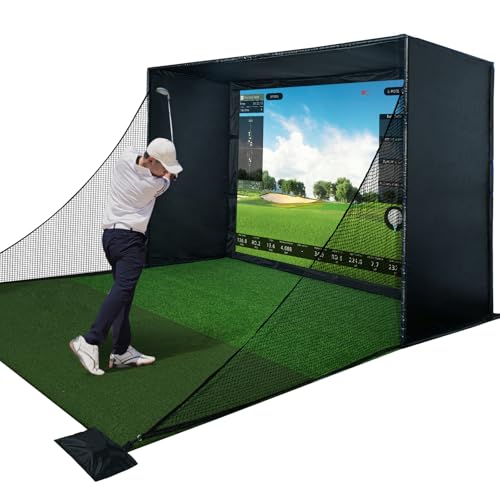
- ✓ Easy tool-free assembly
- ✓ Heavy-duty, durable build
- ✓ Excellent impact screen quality
- ✕ Slightly pricey
- ✕ Large footprint
| Frame Material | Sturdy steel |
| Impact Screen Material | Premium 3-layer shock-absorbing material |
| Safety Padding | Full-coverage foam and thick sponge padding |
| Enclosure Dimensions | Designed to accommodate full golf swings and ball speeds (exact dimensions not specified, inferred suitable for standard golf practice space) |
| Setup | Tool-free assembly |
| Compatibility | Works with most launch monitor golf systems, projectors, and accessories |
The Durbles Golf Simulator Enclosure Kit immediately impressed me with its sturdy steel frame and comprehensive setup, making it a perfect choice for serious golf enthusiasts looking to practice at home. The full safety padding and reinforced impact screen showcase quality construction designed to withstand heavy golf ball impacts without any hassle. The Golf Simulator Enclosure Kit with HD Impact Screen & Padding is a standout choice in its category.
The triple-layer commercial golf impact screen stands out—its premium 3-layer material not only delivers crisp HD visuals but also absorbs shock and reduces sound, even during high-speed shots. I tested it with some fast drives, and it held up remarkably well, showing no signs of wear after repeated hits. Plus, the foam padding around the enclosure cut ricochets by over 50%, making my practice sessions safer and more controlled. When comparing different best golf simulator cost options, this model stands out for its quality.
Setting up the enclosure was a breeze thanks to the tool-free design, and I appreciated how compatible it is with most launch monitor systems and golf projectors. After a few minutes, I had a professional-looking golf simulator space in my garage that feels durable enough for real golf practice, not just casual hits. At $999.99, this kit offers a solid investment for anyone serious about improving their game indoors.
What Factors Affect the Cost of Golf Simulators?
The cost of golf simulators is influenced by several key factors:
- Technology Quality: The accuracy and realism of a golf simulator are heavily dependent on the technology it uses, including sensors and software. High-end simulators often utilize advanced tracking technology, such as infrared or radar systems, which can significantly increase the cost due to their precision and reliability.
- Screen and Projector Quality: The visual experience provided by the simulator is largely determined by the quality of the screen and projector. A high-definition projector and a durable, impact-resistant screen can add to the overall cost, as they enhance the user experience by providing clearer images and better simulation of real-life golfing conditions.
- Software Features: The variety and depth of software features available in a simulator play a crucial role in its price. Simulators that offer extensive course libraries, realistic ball physics, and customizable gameplay options typically come at a premium, as they provide a more immersive and engaging experience for users.
- Installation and Setup: Some golf simulators are complex and may require professional installation, which can increase costs. The need for additional equipment such as computers or dedicated space can also contribute to the overall investment needed for a fully functional simulator setup.
- Brand Reputation: Established brands often charge higher prices due to their reputation for quality and customer service. Premium brands may offer warranties, support, and additional services that justify the higher cost, making them a preferred choice for serious golfers.
- Additional Accessories: Many golf simulators require or benefit from a range of accessories, such as hitting mats, tees, or swing analyzers. These additional components can significantly increase the total cost, especially if they are designed for compatibility with specific simulators or enhance the overall golfing experience.
What Are the Different Types of Golf Simulators and Their Pricing?
The different types of golf simulators vary in technology, features, and pricing.
- Basic Screen Simulators: These simulators use a projection screen and software to simulate golf courses.
- Infrared Sensor Systems: Utilizing infrared sensors, these systems track the ball’s flight and provide detailed feedback.
- Camera-Based Systems: These simulators rely on high-speed cameras to capture the ball’s movement and swing data.
- High-End Full Swing Simulators: These offer advanced technology with realistic graphics and real-time data analysis.
- Portable Golf Simulators: Designed for easy setup and transport, these simulators are popular for home use or travel.
Basic Screen Simulators: These are typically the most affordable option, costing between $1,000 and $5,000. They provide a simple and engaging way to practice golf indoors, ideal for casual golfers who want to improve their game without a significant investment.
Infrared Sensor Systems: Prices for these simulators usually range from $5,000 to $15,000. They offer improved accuracy and data analysis, making them suitable for serious golfers and coaches who want to refine their skills through detailed feedback on ball speed, launch angle, and spin rates.
Camera-Based Systems: These systems generally range from $2,000 to $10,000, depending on the technology used. They provide exceptional accuracy and can capture a variety of metrics, making them a favorite among both amateur and professional golfers who want comprehensive insights into their performance.
High-End Full Swing Simulators: These can cost anywhere from $15,000 to $50,000 or more, featuring top-of-the-line technology, realistic graphics, and extensive courses. They are often found in commercial settings or high-end home setups and are perfect for golfers who demand the best experience and data analysis.
Portable Golf Simulators: These range from $500 to $4,000, making them accessible for golfers who want to practice on the go. They are designed for convenience and typically include a smaller footprint and easier setup, appealing to those with limited space or who travel frequently.
How Do Launch Monitors Compare in Price and Features?
| Feature | Launch Monitor A | Launch Monitor B | Launch Monitor C |
|---|---|---|---|
| Price | $500 – Budget-friendly for casual players | $1,200 – Mid-range with good accuracy | $3,000 – High-end with advanced features |
| Accuracy | Moderate – Good for general play | High – Reliable for professional training | Very High – Used by tour professionals |
| Features | Basic metrics – Distance, ball speed | Advanced metrics – Spin rate, launch angle | Comprehensive analysis – 3D simulations, course play |
| Portability | Lightweight and easily portable | Moderately portable, requires setup | Stationary, designed for indoor use |
| Battery Life/Power Source | Rechargeable battery, lasts 10 hours | AC power, no battery | AC power, requires continuous power |
| Compatibility | Compatible with basic golf apps | Works with advanced simulators and apps | Full integration with multiple high-end software |
| Warranty | 1-year warranty | 2-year warranty | 3-year warranty with premium support |
| User Ratings | 4.0/5 based on user feedback | 4.5/5 with professional recommendations | 4.8/5 highly rated by tour players |
What Should I Expect from Mid-Range Golf Simulators in Terms of Value?
When considering mid-range golf simulators, you can expect a balance of performance, features, and affordability.
- Price Range: Mid-range golf simulators typically cost between $2,000 to $5,000.
- Accuracy: These simulators often utilize advanced technology to provide accurate ball tracking and shot analysis.
- Software Features: Mid-range options usually come with a variety of software packages that include multiple courses and practice modes.
- Portability: Many mid-range simulators are designed to be more portable than high-end models, making them easier to set up and store.
- Build Quality: Expect solid construction, though not as robust as premium models, ensuring durability for regular use.
The price range of mid-range golf simulators generally falls between $2,000 to $5,000, making them more accessible to serious enthusiasts who want quality without breaking the bank. This price point often includes essential features that appeal to both beginners and intermediate players.
Accuracy is a significant aspect of mid-range simulators, as they typically use advanced technology like infrared sensors or dual-camera systems to track ball flight and provide reliable data on distance, speed, and spin. While they may not match the precision of high-end models, they offer a satisfactory experience for most users.
In terms of software features, mid-range simulators come equipped with various software packages that provide access to multiple golf courses, practice drills, and even multiplayer options. This variety enhances the experience by allowing users to play in different environments and improve their skills through targeted practice.
Portability is another advantage of mid-range golf simulators, as many are designed to be user-friendly, enabling easy setup and breakdown. This is particularly beneficial for users who may want to move their simulator between locations or store it when not in use.
Lastly, while the build quality of mid-range golf simulators is generally solid, it may not be as robust as that of premium models. However, they are constructed to withstand regular use and provide a good balance of durability and cost-effectiveness for avid golfers looking to improve their game.
What Justifies the Higher Costs of Premium Golf Simulators?
- Advanced Technology: Premium golf simulators often utilize cutting-edge technology such as high-speed cameras, infrared sensors, and sophisticated software to provide accurate ball tracking and realistic simulations. This technology allows for a more immersive experience, enhancing the golfer’s ability to analyze their swing and improve their game.
- Realistic Graphics and Environments: Many high-end simulators feature high-definition graphics and detailed course reproductions of famous golf courses around the world. This level of detail not only makes the experience more enjoyable but also helps players to visualize shots better, which is crucial for practice and improvement.
- Customizable Features: Premium golf simulators often come with a range of customizable settings that allow users to tailor the experience to their preferences. Features like adjustable weather conditions, course selection, and skill level simulations provide a personalized experience that basic models typically lack.
- Durability and Build Quality: Higher-priced simulators tend to be constructed from more durable materials, ensuring they can withstand the rigors of regular use. This investment in quality means that they are less likely to need repairs or replacements, offering better long-term value.
- Comprehensive Software Packages: Premium models often include extensive software that provides a wealth of data and analytics on performance. This software can include features such as swing analysis, game improvement drills, and multiplayer options, which enhance the training experience and make it more engaging.
- Support and Warranty: Investing in a premium golf simulator typically comes with better customer support and warranty options. Manufacturers often provide thorough technical support and extended warranties, giving buyers peace of mind regarding their investment.
What Is the Average Price Range for Golf Simulators on the Market?
When considering golf simulators, the cost varies significantly based on features, technology, and brand. Here’s a breakdown of the average price range:
-
Entry-Level Simulators ($300 – $2,000): Basic setups typically include a mat, hitting net, and some software. These are suitable for casual golfers or those just starting.
-
Mid-Range Simulators ($2,000 – $5,000): These offer better accuracy, advanced software, and improved hardware, such as infrared sensors or camera technology. This range caters to more serious golfers who desire an authentic experience.
-
High-End Simulators ($5,000 – $20,000+): Professional-grade systems come with high-definition graphics, precise tracking systems, and extensive software inclusions. Ideal for dedicated players or commercial use in golf studios.
-
Additional Costs: Keep in mind that installation, accessories (like a projector or extra software), and maintenance may add to the overall expenditure. It’s wise to budget for these potential additions.
Understanding these ranges can help in making an informed decision when investing in a golf simulator that best fits your needs and budget.
How Do Installation and Maintenance Costs Impact Overall Simulator Expenses?
- Installation Costs: The initial setup involves various expenses including hardware, software, and sometimes construction modifications to accommodate the simulator. Professionals might be required for installation to ensure optimal performance, which can increase costs significantly.
- Calibration and Setup: After installation, proper calibration of the simulator is essential for accuracy in measurements and feedback. This process may require expert assistance and could involve additional costs, particularly if adjustments are needed over time.
- Maintenance Costs: Regular maintenance is necessary to keep the simulator functioning optimally, which can include software updates, hardware repairs, and routine checks. These ongoing expenses can add up and should be factored into the total cost of ownership.
- Upgrades and Compatibility: As technology evolves, you may find the need to upgrade components or software to maintain compatibility with new features or improvements. This can lead to additional costs that should be anticipated when budgeting for a golf simulator.
- Insurance and Warranty: Depending on the investment, obtaining insurance for the simulator against damage or failure can add to overall costs. Additionally, warranties may cover certain repairs but often come with their own fees, influencing the long-term cost considerations.
What Are the Best Budget-Friendly Golf Simulators Available Today?
Some of the best budget-friendly golf simulators available today include:
- SkyTrak Launch Monitor: The SkyTrak is a portable launch monitor that provides accurate data on ball flight and performance. It connects via Wi-Fi to your device for easy setup and use, making it a popular choice for those looking for a budget-friendly option without sacrificing quality.
- OptiShot 2 Golf Simulator: The OptiShot 2 is an affordable indoor golf simulator that uses infrared sensors to track your swing and ball flight. It comes with a variety of courses and is compatible with many devices, allowing users to practice and play without needing a large space.
- Rapsodo Mobile Launch Monitor: This portable device uses your smartphone’s camera to provide data on your golf game, including swing speed and launch angle. Its compact design and lower cost make it an excellent choice for golfers looking to improve without a significant investment.
- Phigolf WGT Edition: Phigolf combines a motion-sensing device with a golf simulator app, allowing you to play on a virtual course using a real swing motion. It’s a fun and interactive way to practice your game, and its price point makes it accessible for many golfers.
- Mevo Plus: The Mevo Plus is a compact launch monitor that offers a range of features, including 3D shot tracking and simulation capabilities. It is designed for both practice and play, providing comprehensive feedback on your performance while remaining budget-friendly.
What Key Considerations Should I Keep in Mind Before Purchasing a Golf Simulator?
Realism and Accuracy: The realism of a simulator’s graphics and its ability to accurately replicate ball flight dynamics are essential for effective practice. Look for reviews and comparisons to find models known for delivering a high level of accuracy and immersive experiences.
Portability: If you plan to use your simulator in different locations or want the flexibility to store it away when not in use, portability becomes a key consideration. Models that are lightweight or foldable can save you time and effort during setup and takedown.
Customer Support and Warranty: A good warranty and reliable customer service are important when investing in technology like a golf simulator. Research the company’s support track record and warranty coverage to ensure you will receive assistance if issues arise after your purchase.
Related Post: