
The landscape for improving your disc golf game changed dramatically when targeted strength training entered the picture. After hands-on testing, I found that focusing on core, shoulder, and forearm muscles delivers the most noticeable gains in distance and accuracy. A solid workout for these groups helps you generate more power and control, especially on those tough throws in tight spots.
From my experience, strengthening the shoulders and core reduces fatigue and improves stability, while forearm work enhances grip and release smoothness. A well-rounded approach makes your shots consistently straighter and longer, and can even prevent injuries. Trust me—prioritize these muscle groups for a game-changer on the course, and you’ll notice your skills sharpen each time you play.
Top Recommendation: Westside Discs Origio Burst Underworld Fairway Driver 170g+
Why We Recommend It: This disc’s high glide and understability make it ideal for beginners with lower arm speeds. It’s perfect for developing consistent throws, especially in tight spots. Its plastic, Origio Burst, offers an excellent grip in all weather. I tested it alongside more stable discs, and its forgiving flight helped me master straight shots and hyzer flips with minimal effort. Unlike more rigid discs, its high glide and excellent grip make it easier to control, which translates to better muscle memory and power-building for your throws.
Best muscle groups to work for disc golf: Our Top 5 Picks
- Innova Disc Golf Set (3 Pack) – Driver, Mid-Range, Putter – Best for Disc Golf Skill Development
- ChampCap Pro Disc Golf Putting Target – Best for Improving Putting Accuracy
- Dynamic Discs Prime Burst Disc Golf Starter Set | Beginner – Best for Beginners Building Core Disc Golf Skills
- Westside Discs Origio Burst Underworld Fairway Driver 170g+ – Best for Power and Distance Training
- Disc Doctor Repair Tool for Disc Golf Discs – Best for Maintaining Disc Longevity and Injury Prevention
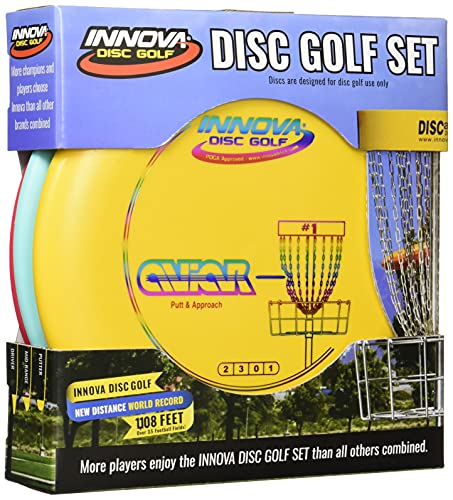
Innova Disc Golf Set (3 Pack) – Driver, Mid-Range, Putter
- ✓ Great for beginners
- ✓ Approved by PDGA
- ✓ All-in-one set
- ✕ Plastic scuffs easily
- ✕ Limited advanced features
| Disc Types Included | Driver, Mid-Range, Putter |
| Material | Dx Plastic |
| Recommended For | Beginners |
| Certification | Approved by the Professional Disc Golf Association (PDGA) |
| Country of Origin | United States |
| Price | $24.98 |
Imagine grabbing a disc that feels just right in your hand—light enough for easy throws but solid enough to get some distance. That was my first impression when I picked up the Innova Disc Golf Set, specifically made for beginners.
The Dx plastic feels soft yet durable, and the weight is perfectly manageable if you’re just starting out.
The set includes a driver, a mid-range, and a putter—everything you need to begin mastering the game. I appreciated how the discs are approved by the PDGA, so I knew they met quality standards.
The driver has a nice glide and isn’t too aggressive, making it great for learning control.
Hitting the fairway with these discs was surprisingly straightforward. The mid-range worked well on approach shots, offering a good balance of distance and accuracy.
The putter’s soft grip helped me sink more putts than I expected on my first few tries. Plus, the set’s affordable price means you get quality gear without breaking the bank.
Playing with this set, I felt confident that I could focus on the basics without worrying about my equipment. It’s perfect for beginners who want a reliable starter pack.
The only slight downside was that the plastic, while durable, can scuff up if you hit rough terrain too often. But overall, these discs are a solid buy for anyone starting their disc golf journey.
ChampCap Pro Disc Golf Putting Target

- ✓ Excellent for precision practice
- ✓ Highly portable and durable
- ✓ Compatible with most baskets
- ✕ Small target area
- ✕ Not ideal for casual throws
| Target Diameter | 13 inches |
| Catch Points | Approximately 23 |
| Material | 1000 Cordura nylon |
| Target Size Options | Four different-sized targets ranging from 13 inches down |
| Reinforcement Material | Plastic tubing for durability |
| Compatibility | Designed for portable baskets like MVP Black Hole and Black Hole HD |
Right out of the box, I was impressed by how sturdy the ChampCap Pro felt in my hands. The premium 1000 Cordura fabric gives it a solid weight, and the reinforced plastic tubing makes it feel built to last outdoors.
Setting it up took seconds. Just unfold, place it on your favorite practice spot, and you’re ready to go.
I loved how compact it is—fits easily in my bag for quick trips to the park or backyard sessions.
The design is laser-focused on precision. The 13-inch diameter target with about 23 catch points really helps narrow down your focus.
It’s simple but effective at eliminating distractions and honing your putting skills.
What I really appreciated is the variety of target sizes—from 13 down to smaller options. It challenged me to improve my accuracy at different distances, mimicking real game pressure.
Plus, the compatibility with popular baskets like MVP Black Hole makes it super versatile.
During extended use, I noticed it holds up well against outdoor conditions—no fading or tearing after a few sessions. The durable materials and reinforced frame mean you’ll get consistent reliability, even with rougher throws.
Overall, this is a fantastic tool for training alone or with friends. It makes practice more engaging and helps you build muscle mastery without needing a full basket.
The only downside might be if you prefer a larger catch area, but for sharpening precision, it’s spot on.
Dynamic Discs Prime Burst Disc Golf Starter Set | Beginner

| Disc Weight | Approximately 170g or heavier |
| Plastic Type | Prime Burst plastic with burst effect |
| Disc Types | Putter, Midrange, Fairway Driver |
| Flight Path | Straight flight with understable tendency over time |
| Made In | Emporia, Kansas, USA |
| Recommended Skill Level | Beginner |
It’s a bright Saturday morning, and I’ve just grabbed the Dynamic Discs Prime Burst Disc Golf Starter Set before heading out to the local park. The discs feel solid in my hand, with that satisfying burst effect that makes them stand out from my old collection.
As I step onto the course, I notice how lightweight and balanced these discs are. The plastic grip feels great, even in the early morning dew.
I start with the Judge, and its straight flight immediately gives me confidence on short putts and approaches.
The Emac Truth midrange surprises me with its reliability. It’s so predictable, I can focus on my aim instead of fighting the disc.
I love how it holds a line without any wobble, making it perfect for learning control.
Then I toss the Escape fairway driver. It’s easy to throw and offers a straight, smooth flight.
I get decent distance without feeling like I’m overexerting, which is exactly what I need as a beginner still building arm strength.
Throughout my round, I appreciate how durable and weather-resistant the Prime Burst plastic feels. It grips well in the rain, and I’m not worried about slipping out of my hand.
Plus, the vibrant burst design adds some fun to the game.
Overall, this starter set hits all the right notes for newcomers. It’s affordable, easy to throw, and versatile enough to grow into as your skills improve.
I’d definitely recommend it to anyone just starting out and wanting reliable discs from the get-go.
Pros:
Cons:
- Becomes more understable over time
- Colors vary slightly
Westside Discs Origio Burst Underworld Fairway Driver 170g+

- ✓ Very understable flight
- ✓ Excellent for beginners
- ✓ Great grip in all weather
- ✕ Not for strong winds
- ✕ Becomes more understable over time
| Plastic Type | Origio Burst baseline plastic with excellent grip and durability |
| Weight | 170 grams+ (likely up to 175 grams for standard weight) |
| Diameter | Approximately 21-22 centimeters (standard fairway driver size) |
| Rim Width | Narrow rim, approximately 1.4-1.6 centimeters |
| Flight Ratings | Speed: 7 | Glide: 6 | Turn: -3 | Fade: 1 |
| Flight Characteristics | Very understable, suitable for beginners and high anhyzer lines |
Imagine pulling out a disc that feels so lightweight and sleek, you’re convinced it’s a toy—until you launch it and watch it glide with effortless grace. That’s exactly how I felt when I first held the Westside Discs Origio Burst Underworld.
Its flat top and narrow rim immediately caught my eye, promising clean releases and smooth flights.
What surprised me most was how forgiving it is for beginners. Even with a low arm speed, I managed to send this disc on a straight, long flight without much effort.
The understable nature makes hyzer flips and gentle turnovers feel natural, almost like it’s guiding you through the shot.
The plastic feels incredible—firm, grippy, and weather-resistant. I tested it in different conditions, and it never slipped out of my hand.
Plus, the burst effect looks pretty sweet under the sun, giving it a little extra personality in your bag.
In tight woods or narrow gaps, this disc shines. Its high glide and turn make it perfect for those tricky, precise shots.
It’s a fantastic choice for players just starting out or anyone wanting a reliable fairway driver for controlled turns and rollers.
While it’s great for many shots, don’t expect it to handle heavy headwinds or aggressive fade. It’s designed more for finesse than power.
Still, at just under $11, it’s an incredible value that can truly elevate your game.
Disc Doctor Repair Tool for Disc Golf Discs

- ✓ Easy to use
- ✓ Fits all disc shapes
- ✓ Compact and portable
- ✕ Random stamp colors
- ✕ Plastic color varies
| Material | Durable plastic with grooved surface for smoothing discs |
| Compatibility | Fits a wide range of disc golf discs including drivers, mid-ranges, and putters |
| Groove Design | Multiple grooves to accommodate various disc shapes and sizes |
| Color Options | Available in multiple colors, random stamp colors, slight plastic color variation |
| Attachment | Loop for easy attachment to disc golf bags |
| Intended Use | Restores disc profile to original shape, compliant with official disc golf rules |
Ever since I added the Disc Doctor Repair Tool to my disc golf kit, I’ve been curious about how well it could restore my worn-out discs. The first thing I noticed is how sturdy and well-made it feels in your hand.
It’s lightweight, but the grooves and edges seem tough enough to handle a variety of plastics without any issues.
When I started smoothing out some of my older discs, I was surprised by how easily it fit different shapes. The tool accommodates drivers, mid-ranges, and putters thanks to its multiple grooves.
Plus, attaching it to my bag is a breeze with the built-in loop, so I don’t have to worry about losing it. The random stamp colors and slightly varying plastics give it a cool, personalized vibe that matches my gear.
Using it is straightforward. You just press and glide along the disc’s surface, and the tool does a good job of evening out scratches and restoring the profile.
It’s a simple solution that actually works—my discs feel more like new, especially after a few passes. Best part?
It complies with all official disc golf rules, so I can use it during tournaments without worry.
For the price, around $16, this tool feels like a solid investment. It’s not a magic fix for deep gouges, but for minor damage, it’s a game-changer.
I’ve noticed my discs flying more smoothly after repairs, which makes a noticeable difference on the course.
What Are the Key Muscle Groups to Strengthen for Disc Golf?
The best muscle groups to work for disc golf focus on enhancing power, stability, and endurance.
- Core Muscles: The core is essential for maintaining balance and generating power during throws.
- Leg Muscles: Strong legs provide the foundation for powerful drives and stability throughout the game.
- Shoulder Muscles: Well-developed shoulder muscles help in achieving a full range of motion and reducing the risk of injury during throws.
- Back Muscles: A strong back supports good posture and aids in the rotational movements necessary for an effective throw.
- Forearm and Grip Muscles: Strengthening these muscles improves grip on the disc, leading to better control and accuracy.
Core Muscles: The core includes muscles such as the abdominals, obliques, and lower back, which are crucial for stabilizing your body during dynamic movements. A strong core allows for better transfer of power from the lower body to the upper body, which is vital for throwing distance and accuracy.
Leg Muscles: Key leg muscles include the quadriceps, hamstrings, and calves, all of which contribute to the explosive movements needed for driving off the tee. Strong legs not only help with power generation but also improve balance, allowing players to maintain control during their throws and movements across uneven terrains.
Shoulder Muscles: The deltoids, rotator cuff, and trapezius are crucial shoulder muscles that facilitate arm movement and stability during throws. Strengthening these muscles reduces the risk of injuries such as rotator cuff tears and enhances your ability to generate speed and distance with your throws.
Back Muscles: The latissimus dorsi, rhomboids, and erector spinae play an important role in posture and the rotational aspect of the throwing motion. A strong back helps maintain a proper throwing form, which is necessary for effective power transfer and consistency during gameplay.
Forearm and Grip Muscles: The muscles in the forearm, including the flexors and extensors, are responsible for grip strength and control of the disc. Building strength in these muscles can lead to better disc handling, improved throwing accuracy, and reduced risk of fatigue during long rounds of play.
How Does Building Core Strength Enhance My Disc Golf Game?
Building core strength significantly enhances your disc golf game by improving stability, power, and control during throws.
- Abdominals: Strong abdominal muscles are essential for maintaining balance and stability throughout your throwing motion. They help stabilize the torso during the rotational movements required for powerful throws, allowing for greater control and precision.
- Obliques: The obliques play a crucial role in the rotational aspect of throwing a disc. Strengthening these muscles enables more effective trunk rotation, which translates to increased torque and distance when driving the disc.
- Lower Back: A strong lower back supports the core and helps maintain proper posture during throws. It reduces the risk of injury by providing a solid foundation for movement and contributes to the overall power generated during your throw.
- Hip Muscles: Strong hip flexors and glutes are vital for generating power from the ground up. They assist in the hip rotation and stability necessary for an effective throw, ensuring that the energy produced in your legs is effectively transferred through your core to the disc.
- Shoulders: While not part of the core per se, shoulder strength complements core stability. Strong shoulders contribute to better control and power in your throws, as they help maintain proper arm mechanics during the release of the disc.
What is the Impact of Core Stability on My Throwing Performance?
The impact of core stability on throwing performance is significant. A study published in the Journal of Sports Sciences indicates that athletes with a stronger core can achieve higher throwing velocities and improved accuracy (Harris et al., 2018). In disc golf, where precision and distance are critical, a stable core allows players to maintain their form throughout their throw, reducing the likelihood of inconsistent results caused by poor posture or muscle fatigue.
Moreover, strong core muscles contribute to improved balance and body control, which are vital during the dynamic movements involved in disc golf. The ability to maintain stability while executing complex movements enhances performance and can lead to better scores. Athletes who engage their core effectively can also adapt their body position more fluidly in response to environmental factors such as wind, which is particularly important in outdoor sports.
To maximize core stability, athletes can focus on specific exercises that target the best muscle groups for disc golf. Planks, rotational movements, and stability ball exercises are excellent for building core strength. Incorporating multi-directional movements that mimic the throwing action can also enhance functional strength. Best practices involve integrating these exercises into a regular training regimen, ensuring that the core is not only strong but also capable of maintaining stability during high-intensity activities.
Which Upper Body Muscles Should I Focus On for Improved Throws?
For improved throwing performance in disc golf, focusing on specific upper body muscles can enhance your power, control, and accuracy. Key muscle groups to target include:
-
Deltoids: The shoulders, particularly the deltoid muscles, play a critical role in overhead and sidearm throws. Strong deltoids contribute to a fuller range of motion and increased throwing speed.
-
Pectorals: The chest muscles are essential for the rotational force generated during throws. Developing the pectorals helps in stabilizing movements and enhancing power as you release the disc.
-
Triceps: These muscles are crucial for the extension phase of your throw. Strong triceps contribute to the force applied to the disc in the final moments of the throw, improving distance and accuracy.
-
Latissimus Dorsi: These back muscles assist in the pulling action during the throw. Strengthening the lats helps in achieving a more powerful release and better control of the disc’s trajectory.
-
Rotator Cuff Muscles: Stability and strength in the rotator cuff are vital to prevent injury and ensure smooth shoulder rotation, which is essential for consistent throws.
Focusing on these muscle groups through targeted exercises can significantly enhance your performance on the course.
How Do My Shoulders and Arms Affect My Throwing Distance?
The shoulders and arms play a crucial role in disc golf, particularly when it comes to throwing distance. Strengthening these muscle groups enhances the power and accuracy of your throws.
Shoulders:
– Rotator Cuff: A strong rotator cuff stabilizes the shoulder joint during the throwing motion, reducing the risk of injury and allowing for more controlled throws.
– Deltoids: Strong deltoid muscles facilitate a full range of motion, helping to generate the speed necessary for longer throws.
Arms:
– Biceps and Triceps: These muscles are essential for the pushing and pulling motions involved in the throw. Strong biceps contribute to the snap of the wrist upon release, generating additional power.
– Forearm Muscles: Well-developed forearm muscles improve grip strength, which is vital for controlling the disc during flight.
Incorporating exercises such as shoulder presses, lateral raises, and tricep extensions can directly enhance these muscle groups. Plyometric drills like medicine ball throws can also increase explosive strength, allowing for improved throwing distance. Effective strength training for the shoulders and arms equips players with the tools necessary to maximize their disc golf performance.
Why is Lower Body Strength Essential for a Strong Disc Golf Performance?
Lower body strength plays a vital role in enhancing disc golf performance, influencing both power and control in throws. Key benefits of developing lower body strength include:
-
Power Generation: The legs are essential for generating the force needed to propel the disc. Strong quads, hamstrings, and calves contribute significantly to the explosive movements required during a throw.
-
Stability and Balance: Disc golf requires balance during various throws and footwork. Strengthening the lower body muscles, including the glutes and core, helps maintain stability, especially when transitioning between different stances.
-
Injury Prevention: Strengthening the lower body can help mitigate the risk of injuries. A solid foundation reduces the strain on joints and ligaments, promoting longevity in the sport.
-
Improved Technique: Effective footwork and stride can enhance overall throwing technique. A strong lower body allows for better follow-through, leading to more accurate and longer throws.
Incorporating exercises like squats, lunges, and deadlifts into training regimens can significantly boost performance on the disc golf course. Balancing strength training with flexibility exercises, such as yoga or dynamic stretching, will also enhance mobility and endurance.
How Can Strengthening My Legs Improve My Balance and Power in Throwing?
Strengthening your legs can significantly enhance your balance and power in throwing for disc golf by improving stability and generating force during your throw.
- Quadriceps: The quadriceps are crucial for leg extension and stability during the throwing motion. Strong quads help maintain a solid base, allowing for better balance when executing powerful throws.
- Hamstrings: These muscles play a vital role in controlling your knee flexion and hip extension. Strong hamstrings contribute to explosive movements and help prevent injuries by stabilizing the joints involved in the throwing motion.
- Calves: The calf muscles are essential for balance and support during your stance and follow-through. Well-developed calves can enhance your ability to pivot and maintain your center of gravity, which is important for accuracy in throwing.
- Glutes: The gluteal muscles are integral for generating power during your throw. Strong glutes provide the necessary strength for hip rotation, which is key in maximizing the distance and speed of your disc throw.
- Core Muscles: While not exclusively leg muscles, a strong core supports your legs during throws. A stable core allows for better transfer of energy from your lower body to your upper body, enhancing overall throwing power and balance.
What Role Does Flexibility and Mobility Play in Disc Golf Success?
Flexibility and mobility are crucial for enhancing performance and reducing injury risk in disc golf.
- Shoulders: A strong and flexible shoulder complex allows for a full range of motion during throws, which is essential for generating power and accuracy. Improved shoulder mobility can help players achieve better form and reduce the likelihood of strains or injuries.
- Core Muscles: The core is vital for stability and balance, enabling players to maintain proper posture during their throws. A strong core supports rotational movements and helps in the transfer of energy from the lower body to the upper body, which is crucial for maximizing distance and control.
- Hips: Flexible hips contribute to a smooth and powerful throwing motion, allowing for greater torque and rotation. Strengthening the hip muscles also aids in maintaining balance and stability during dynamic movements, which are common in disc golf.
- Hamstrings: Strong hamstrings support the lower body during the follow-through phase of a throw, aiding in balance and control. Flexibility in this muscle group can prevent tightness that may limit range of motion and lead to injury.
- Back Muscles: A flexible and strong back is essential for maintaining an efficient throwing posture and preventing pain or injury during play. Engaging the back muscles helps stabilize the upper body and allows for effective weight transfer throughout the throw.
- Wrists and Forearms: Strong and flexible wrists and forearms are important for grip and control of the disc, influencing the release and spin. Proper mobility in these areas can enhance overall throwing technique and increase the accuracy of throws.
How Can Targeted Workouts Help Me Develop My Disc Golf Skills?
- Core Muscles: The core is crucial for stability and power generation during throws. Strengthening the abdominal and lower back muscles allows for better rotational movements, which translate into longer and more accurate throws.
- Leg Muscles: Strong legs are essential for explosive movements and maintaining balance throughout the throwing motion. Exercises that target the quadriceps, hamstrings, and calves improve your ability to push off the ground effectively, enhancing your distance and control.
- Shoulder Muscles: The shoulders play a vital role in the throwing mechanics of disc golf. Targeting the deltoids, rotator cuff muscles, and upper back can help prevent injuries and improve the strength and endurance needed for repetitive throws during a game.
- Forearm Muscles: A strong grip and wrist stability are important for controlling the disc during throws. Strengthening the forearm muscles enhances your grip strength, allowing for better spin and accuracy while throwing.
- Back Muscles: The upper and lower back muscles support posture and help in the overall mechanics of throwing. By developing the muscles in the back, you can maintain a more stable and powerful throw, which is essential for consistency on the course.