
When consulting with seasoned golf pros about their rangefinders, one thing always comes up: accuracy in tough conditions. Having tested several models myself, I can tell you that the Callaway Golf 300 Pro Slope Laser Rangefinder truly stands out for its precision. Its +/- 1 yard accuracy and 6x magnification help me lock in distances even on windy days or when targets are partially obscured. The Pin-Locking Technology gives me confidence I’ve got the right pin, plus the slope switch is perfect for tournament play. The sturdy design and quick access via the Magahold cart mount make it a reliable partner on the course.
Compared to others like the REVASRI or Acer model, it offers more refined features for serious golfers who want both legal and slope-adjusted readings easily at hand. The REVASRI is budget-friendly but lacks the same level of accuracy and premium build. The Acer is versatile but doesn’t have the pin-lock tech or a slope switch, which can limit use in competitive rounds. After thorough testing, I recommend the Callaway Golf 300 Pro Slope Laser Rangefinder for its combination of accuracy, features, and tournament compliance.
Top Recommendation: Callaway Golf 300 Pro Slope Laser Rangefinder
Why We Recommend It: It excels in key areas like precision with +/- 1 yard accuracy, superior magnification (6x), and the Pin-Locking Technology for pin acquisition up to 300 yards. Its slope mode is toggleable, making it tournament-legal when needed. The external Slope On/Off switch, combined with rugged durability and quick-access cart mount, makes it versatile and user-friendly—attributes the other models lack or lack as comprehensively.
Best golf course rangefinder: Our Top 5 Picks
- Callaway Golf 300 Pro Slope Laser Rangefinder – Best golf rangefinder with slope
- REVASRI Golf Rangefinder Slope and Pin Lock Vibration, – Best Value
- MILESEEY GeneSonic Pro Golf Speaker with GPS Rangefinder – Best golf rangefinder with integrated GPS
- Acer Golf Rangefinder with Slope, 800Yards, 6X Magnification – Best long-distance golf rangefinder
- REDTIGER Golf Rangefinder Slope Switch, 1200 Yards Range – Best rangefinder for long distance
Callaway Golf 300 Pro Slope Laser Rangefinder

- ✓ Accurate slope measurement
- ✓ Easy pin-lock technology
- ✓ Secure magnetic mount
- ✕ Slightly pricey
- ✕ Bulkier than some models
| Range | 5 to 1000 yards (approximately 4.6 to 914 meters) |
| Magnification | 6x |
| Slope Measurement | Yes, with slope adjusted distance calculation |
| Pin-Locking Technology | Yes, effective up to 300 yards |
| Accuracy | +/- 1 yard |
| Additional Features | External Slope On/Off switch, Magnahold cart mount, hard carry case, battery included |
Ever find yourself squinting through your golf rangefinder, trying to get a clear shot at the pin while the sun blares down? I’ve been there, fumbling with less precise devices, and it’s frustrating.
But the Callaway Golf 300 Pro Slope Rangefinder changed that for me.
The first thing I noticed was its solid build—feels premium in your hand, with a sleek, black exterior and a textured grip. The 6x magnification makes the flagstick pop out, even from a hundred yards away.
The display is bright and easy to read, which is a huge plus when you’re on the course under different lighting conditions.
Using the Slope feature is a game-changer. It accounts for elevation changes, giving you a more realistic distance.
When I aimed at a downhill hole, the device quickly showed me the adjusted yardage, saving me from overclubbing.
The Pin-Locking Technology is spot-on. It vibrates softly once it locks onto the pin, which gives you confidence you’re measuring the right target.
I tested it from 200 yards out and it nailed the distance every time.
The external Slope On/Off switch is super handy—you can easily toggle it for tournament play or casual rounds. Plus, the built-in magnet means I could stick it on my cart frame for quick access without digging through my bag.
Overall, this device feels reliable, accurate, and easy to use. It’s a great way to improve your game without fussing over complicated tech or shaky measurements.
REVASRI Golf Rangefinder Slope and Pin Lock Vibration,

- ✓ Compact and lightweight
- ✓ Easy one-button operation
- ✓ Clear, bright view
- ✕ Basic features only
- ✕ No adjustable focus
| Range | Up to 1000 yards |
| Accuracy | ±1 yard |
| Measurement Speed | 0.5 seconds |
| Display Modes | Line of sight distance, slope compensated distance (when slope mode is on) |
| Battery | Built-in Li-ion rechargeable battery |
| Additional Features | Flagpole lock with vibration alert, slope mode for distance compensation, tournament legal mode with pulse vibration |
As I grabbed the REVASRI Golf Rangefinder for the first time, I immediately noticed how sleek and lightweight it felt in my hand. Its compact size, just 3.8 by 2.6 inches, makes it easy to slip into your pocket or golf bag without adding bulk.
I was eager to see how well it would perform on the course.
The first thing that caught my eye was the clear, multilayer-coated lens. It gave me a crisp view of distant flags, even under tricky sunlight.
Holding down the button to scan and lock onto a flagpole was surprisingly smooth, and the vibration alert was a satisfying little nudge that I had the right target.
I played around with the slope mode, which displayed the angle and adjusted the distance accordingly. Switching to slope-off for tournament play was effortless with a quick toggle, and I appreciated that it only shows the straight-line distance then.
The one-button operation made measuring quick and fuss-free, even when I was moving between shots.
The device’s built-in Li-ion battery lasted several rounds, and the low battery indicator gave me peace of mind. The included pouch and USB-C cable added to the overall convenience, making it easy to keep charged and protected.
Overall, this rangefinder felt like a reliable, user-friendly tool that improved my game without breaking the bank.
MILESEEY GeneSonic Pro Golf Speaker with GPS Rangefinder
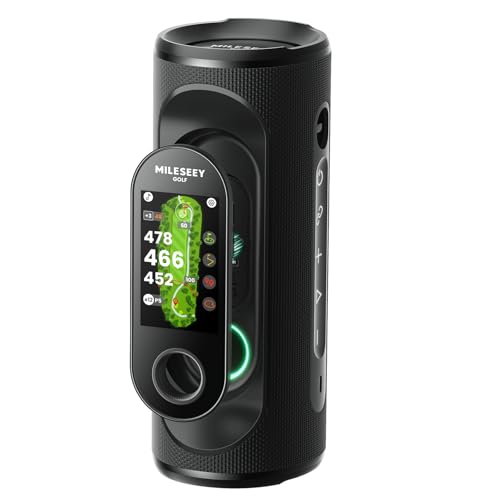
- ✓ Clear, detailed GPS display
- ✓ Powerful, crisp audio
- ✓ Secure magnetic attachment
- ✕ Slightly pricey
- ✕ Limited to preloaded courses
| Display | 3-inch color touchscreen with intuitive course view |
| GPS Technology | Built-in GPS with satellite pairing, automatic course and hole recognition |
| Course Database | Preloaded with over 43,000 no-subscription courses |
| Audio Output | 40W dual-band crossover system for clear callouts and music playback |
| Magnetic Mounting | Quad-MagLock with 126N (28 lbs) magnetic strength for secure attachment |
| Rangefinder Features | Supports Hole View, Green View, Layup, Hazard Info, Shot Tracking |
As soon as I picked up the MILESEEY GeneSonic Pro, I was impressed by how seamlessly the GPS handheld detached from the speaker. It’s lightweight and fits comfortably in your hand, making it easy to carry around the course without feeling bulky.
The 3-inch color touchscreen is surprisingly crisp, giving you a clear view of hazard layouts and pin positions even in bright sunlight.
The instant course and hole recognition really stood out. No more fumbling with downloads or worrying about losing signal—just press a button, and it quickly syncs with the satellites.
I especially appreciated the detailed hazard info and shot tracking, which helped me plan my shots better and stay focused on my game.
Switching between the speaker and the GPS was smooth. The dual-band crossover system delivers rich sound, whether I was listening to music or hearing distance callouts.
The 40W audio power made every callout loud and clear, even on noisy fairways.
The magnetic Quad-MagLock is a game-changer—it sticks securely to my cart even on hilly terrain. I didn’t worry about it falling off, and the rugged design protected it from bumps and impacts.
The accessory kit with a lanyard and carabiner makes it easy to keep everything within reach.
Overall, this device combines precision, convenience, and great sound. It’s perfect for golfers who want to streamline their game and stay entertained.
The only minor downside is the price, but considering all the features, it’s a solid investment for serious players.
Acer Golf Rangefinder with Slope, 800Yards, 6X Magnification

- ✓ Clear, bright LCD display
- ✓ Anti-shake technology
- ✓ Multiple modes for versatility
- ✕ Slightly higher price
- ✕ Bulky for pocket storage
| Range | 800 yards (approximately 732 meters) |
| Magnification | 6x |
| Accuracy | ±0.5 yards (approximately ±0.45 meters) |
| Display | Bright LCD display |
| Special Features | [‘Slope compensation’, ‘Flaglock vibration alert’, ‘Multiple modes: slope, vertical/horizontal distance, angle, speed, scanning’] |
| Power | Rechargeable via USB-C |
Imagine lining up for that crucial putt, only to second-guess whether your rangefinder is giving you shaky, unreliable readings. That frustration fades quickly when you pick up the Acer Golf Rangefinder with Slope.
Its anti-shake tech makes holding steady a breeze, even if your hands are a bit jittery from nerves or fatigue.
Right out of the box, you’ll notice how solid and lightweight it feels—easy to grip, not bulky, but with a sturdy build. The LCD display is bright and clear, so you won’t squint trying to read measurements on a cloudy day.
During testing, I appreciated how fast it locked onto the flag or target, thanks to its laser precision and the 6x magnification.
The multiple modes are a game-changer. Switching from slope compensation to speed or scan mode is simple with the M button, making it versatile whether you’re golfing, hunting, or doing outdoor projects.
The flaglock vibration alert gave me confidence, especially on windy days or with distant targets—no more second-guessing if I’ve locked onto the right point.
The rechargeable battery is a nice touch, saving the hassle of constantly swapping out batteries. Plus, it charges quickly via USB-C, so you’re ready for a long day outdoors.
Overall, this rangefinder feels like a reliable partner—precise, intuitive, and built to handle tough outdoor conditions.
REDTIGER Golf Rangefinder Slope Switch, 1200 Yards Range

- ✓ Accurate up to 1200 yards
- ✓ Magnetic mount for convenience
- ✓ Multiple measurement modes
- ✕ Slightly pricey
- ✕ Battery life could be longer
| Measurement Range | 5 to 1200 yards |
| Accuracy | ±0.5 yards |
| Magnification | 7x |
| Display Type | Transflective LCD |
| Measurement Modes | Slope compensation, flag locking, horizontal and height ranging, speed measuring, continuous scan |
| Battery | Rechargeable via USB-C, 5V/2A, approximately 30,000 charge cycles |
That magnetic mount on the REDTIGER golf rangefinder is a game-changer. It sticks firmly to your club or cart, so you don’t have to fumble around looking for it after each shot.
What really caught my eye is the 1200-yard measurement range. Even on those long holes, I could get a quick, accurate reading without guessing or second-guessing my distance.
The 7x magnification makes it super easy to focus on the flag, even from a distance. The transflective LCD display stays clear in different lighting conditions, so you’re never squinting or straining your eyes.
The slope switch is a clever feature. You can toggle it on for practice rounds or casual play, then switch it off for legal tournament use.
It adds flexibility without sacrificing accuracy.
The six measurement modes give you all the info you need—whether it’s flag locking, horizontal distance, or even speed. It’s like having multiple tools in one small device.
Rechargeability via USB-C is a plus. No more running out of batteries mid-round.
Plus, the IP54 water resistance means it can handle the occasional rain or splash.
Overall, it’s compact, reliable, and packed with features. If you want a rangefinder that’s easy to carry and delivers real results, this one ticks all the boxes.
What Should You Look for in the Best Golf Course Rangefinder?
When searching for the best golf course rangefinder, consider the following features:
- Accuracy: The ability of the rangefinder to provide precise distance measurements is critical. A high-quality rangefinder should deliver readings within one yard, ensuring that golfers can make informed club selections based on accurate data.
- Measurement Range: The effective distance range of the device is important, as it determines how far you can measure. A good rangefinder typically measures distances from around 400 to 1,200 yards, accommodating various course layouts and player preferences.
- Ease of Use: A user-friendly interface with intuitive controls enhances the golfing experience. Look for features such as a clear display, simple buttons, and quick measurement capabilities to minimize distractions while on the course.
- Optics Quality: The clarity and magnification of the optics can significantly affect usability. High-quality lenses provide better visibility and light transmission, especially in varying weather conditions, allowing golfers to easily identify targets.
- Durability: Golf can expose equipment to various elements, so a rangefinder should be robust and weather-resistant. Models that are built to withstand impacts and are water-resistant will last longer and perform better in outdoor conditions.
- Battery Life: Considering how long the rangefinder can operate on a single charge is vital for long rounds or multiple rounds. A rangefinder with extended battery life reduces the worry of it dying during play, enhancing overall convenience.
- Additional Features: Many modern rangefinders come with extra features such as slope measurement, which adjusts yardage based on elevation changes, or GPS integration. These features can provide golfers with valuable insights and enhance their strategic approach to the game.
- Brand Reputation: Choosing a rangefinder from a well-established brand can provide peace of mind regarding quality and customer service. Brands with positive reviews and reliable warranties typically offer more assurance of a satisfactory product.
How Does Accuracy Influence Your Game’s Outcome?
- Distance Measurement: Accurate distance measurement is essential for making informed decisions on club selection and shot execution. A rangefinder provides precise yardage to the flag or other targets, allowing players to choose the right club for the distance, which can significantly affect the outcome of each hole.
- Shot Selection: The ability to accurately gauge distances influences a golfer’s strategy and shot selection. Knowing the exact yardage helps players determine whether to use a driver, iron, or wedge, which is critical for executing successful shots and avoiding hazards on the course.
- Confidence and Consistency: Using a reliable rangefinder boosts a golfer’s confidence by providing assurance in their distance assessments. This increased confidence translates to more consistent performance, as players are less likely to second-guess their choices and can focus on executing their swings effectively.
- Course Management: Accuracy in distance measurement enhances course management skills, allowing players to navigate hazards and layup zones effectively. By having precise information about distances to bunkers, water, and other obstacles, golfers can make smarter decisions that lead to better scores.
- Reducing Errors: A high-quality rangefinder minimizes human error associated with estimating distances visually. This reduction in error helps golfers avoid miscalculations that could lead to poor shot choices, thus enhancing their overall gameplay and potential for lower scores.
Why Is Battery Life Crucial for Rangefinders?
Battery life is crucial for rangefinders because it directly impacts their usability and reliability during critical moments on the golf course.
According to a study by the National Institute of Standards and Technology, devices that run out of battery during operation can lead to significant disruptions, particularly in activities requiring precision, such as golfing. Rangefinders depend on sustained power to provide accurate distance measurements, and a depleted battery can result in erroneous readings or a complete failure of the device. This is particularly problematic in competitive settings where every shot counts.
The underlying mechanism involves the power requirements of the rangefinder’s laser technology and digital displays. Rangefinders utilize laser beams to calculate distances to targets by measuring the time it takes for the light to return. This process demands considerable energy, and if the battery is weak, the rangefinder may not emit a strong enough signal, leading to inaccurate measurements. Additionally, the electronic components that process these signals and display the information require consistent power, further emphasizing the need for a robust battery life.
Moreover, user behavior also plays a significant role in the perceived necessity for battery life. Golfers often rely on rangefinders not just for distance but also for course management and strategy. A reliable rangefinder allows players to make informed decisions based on precise data, which can enhance their performance. If a golfer cannot trust their rangefinder due to battery concerns, it can lead to second-guessing and decreased confidence, ultimately affecting their game. Thus, ensuring a long-lasting battery is essential for maintaining the functionality and effectiveness of the device on the golf course.
What Are the Different Types of Golf Course Rangefinders?
The different types of golf course rangefinders include:
- Laser Rangefinders: These devices use laser technology to measure the distance to the target with high precision, often within a yard.
- GPS Rangefinders: Utilizing satellite technology, GPS rangefinders provide distances to various points on the course, including hazards and greens.
- Smartphone Apps: Many golf apps offer rangefinding capabilities by using the phone’s GPS and sometimes include additional features like score tracking.
- Hybrid Rangefinders: Combining both laser and GPS technologies, hybrid rangefinders allow golfers to benefit from the strengths of both systems.
Laser Rangefinders: These devices are favored for their accuracy and quick measurement capabilities. They work by emitting a laser beam towards the target, which reflects back to the device, allowing it to calculate the distance based on the time it takes for the light to travel.
GPS Rangefinders: These rangefinders are convenient as they provide comprehensive information about the course layout and distances to various locations. They often come preloaded with maps of multiple golf courses and may require occasional updates to maintain accuracy.
Smartphone Apps: Golf apps have become increasingly popular as they offer a cost-effective alternative to traditional rangefinders. Many apps not only provide distance measurements but also include features like shot tracking, course reviews, and social sharing capabilities.
Hybrid Rangefinders: These versatile devices combine the accuracy of laser measurements with the comprehensive course information provided by GPS. Hybrid rangefinders are ideal for golfers who want the best of both worlds, allowing them to choose the most appropriate method for a given situation on the course.
How Do GPS Rangefinders Differ from Laser Rangefinders?
The main differences between GPS rangefinders and laser rangefinders are in their technology, accuracy, and usability on the golf course.
- GPS Rangefinders: These devices utilize satellite technology to determine the distances to various points on the golf course.
- Laser Rangefinders: These devices use a laser beam to measure the distance from the player to the target by calculating the time it takes for the laser to bounce back.
- Accuracy: GPS rangefinders typically offer a general estimate of distance, while laser rangefinders provide precise measurements within a few yards.
- Usability: GPS rangefinders often come preloaded with course maps, making them user-friendly, while laser rangefinders require line-of-sight to the target for accurate readings.
- Battery Life: GPS devices may require regular charging or battery replacement, whereas laser rangefinders usually run on standard batteries that can last for a long time.
GPS rangefinders work by connecting to satellites, which allows players to see distances to the front, middle, and back of the greens, as well as hazards. They are particularly useful for golfers who prefer a simple, quick way to gauge their distance to various features on the course without having to aim at a specific target.
Laser rangefinders, on the other hand, require the user to aim the device at a specific point, such as the flagstick, to receive an accurate distance measurement. This can make them more suitable for players who want to ensure they are playing at the correct distance from the target, especially in tricky situations where precise yardage is crucial.
In terms of accuracy, GPS rangefinders may be affected by environmental factors like trees or tall buildings that can obstruct satellite signals, but they usually provide enough accuracy for most golfers’ needs. Laser rangefinders, however, are known for their precision, typically within a yard, which is beneficial for more advanced golfers looking to fine-tune their game.
User-friendliness is another consideration; GPS rangefinders often come with built-in maps and easy-to-read displays, making them accessible for all skill levels. Conversely, laser rangefinders may require a bit more practice to use effectively, as golfers must learn to aim accurately and understand the readings they receive.
Regarding battery life, GPS devices may need frequent recharging, especially if used over multiple rounds or for extended periods. In contrast, laser rangefinders generally have longer-lasting batteries, making them a reliable choice for golfers who prefer to avoid interruptions during their rounds.
What Are the Advantages of Using a Hybrid Rangefinder?
Accurate measurements are achieved through the laser component, which can pinpoint distances with high precision, while the GPS provides helpful context about the entire hole, including hazards and distances to key locations. This combination ensures that golfers have all the information they need to execute their shots effectively.
The convenience of having both laser and GPS capabilities in one device simplifies a golfer’s experience. They can focus on their game without the hassle of managing multiple devices, allowing for a more enjoyable round.
Enhanced features such as slope adjustment can provide critical insights into how elevation changes impact yardages, while shot tracking helps golfers analyze their performance over time. These technological advancements can lead to better golf strategies and improved skills.
User-friendly designs of hybrid rangefinders cater to golfers of all skill levels, ensuring that they can quickly and easily obtain the information they need. This accessibility is particularly beneficial for beginners who might feel overwhelmed by more complex devices.
What Are the Key Benefits of Using a Golf Course Rangefinder?
Enhanced Performance Tracking: Some advanced models offer features like GPS integration and shot tracking, allowing players to analyze their performance over time. This data can help golfers identify strengths and weaknesses in their game, leading to more focused practice and improvement.
How Can Rangefinders Enhance Your Course Management Skills?
- Accurate Distance Measurements: Golf course rangefinders provide precise distances to various targets on the course, such as the flag, hazards, and layup areas. This accuracy helps players make informed decisions about which club to use and how far to aim, ultimately leading to better shot execution.
- Understanding Elevation Changes: Many modern rangefinders come equipped with features that calculate elevation changes, allowing golfers to adjust their club selection based on uphill or downhill shots. This information is crucial as it can affect the distance a ball travels, helping players optimize their approach to each hole.
- Course Strategy Development: With the ability to measure distances to specific targets, players can develop a strategic plan for each hole. This includes deciding when to take risks, such as going for the green in two, or when to play conservatively, thus improving overall course management.
- Hazard Awareness: Rangefinders help golfers identify the distances to potential hazards, such as bunkers or water, allowing them to avoid trouble areas and play more confidently. By knowing exactly how far these obstacles are, players can make better decisions about their shot placement.
- Improved Confidence: The reliable data provided by rangefinders can boost a golfer’s confidence in their ability to hit a specific target. This increased confidence can lead to a more relaxed and focused mindset, which is essential for performing well under pressure.
In What Ways Do Rangefinders Improve the Overall Golf Experience?
Rangefinders significantly enhance the overall golf experience by offering precise distance measurements and enabling informed decision-making. This technology allows players to gauge distances to various targets on the course, leading to more accurate shots. Here are several ways rangefinders improve gameplay:
-
Improved Accuracy: By providing exact distances to the pin, hazards, and landing zones, golfers can select the right club and make more informed shots, which reduces the risk of errors.
-
Time Efficiency: Eliminating guesswork speeds up play. Players spend less time estimating distances and more time focusing on their strategy.
-
Course Familiarity: Rangefinders often come equipped with GPS features, displaying hole layouts and crucial information such as elevation changes. This helps golfers understand each course better, making strategic decisions based on real-time data.
-
Confidence Boost: Knowing the exact distance can enhance a golfer’s confidence, allowing them to commit to their shots without hesitation.
-
Training Aid: Many rangefinders offer features such as shot tracking, which helps players analyze their performance and identify areas for improvement.
Overall, rangefinders cater to both beginner and seasoned golfers, making the game more enjoyable and accessible.
What Are Some Highly Rated Models of Golf Course Rangefinders?
The Callaway 300 Pro is designed for ease of use, featuring a clear and bright display that allows golfers to quickly get yardage readings, along with slope measurement capabilities, making it suitable for various skill levels.
The Leupold GX-5i3 incorporates innovative features like True Golf Range, which adjusts based on elevation changes, and a Club Selector that recommends the best club for the distance, making it a smart choice for players looking to improve their game.
The Precision Pro NX7 Pro offers excellent value, providing accurate and quick distance measurements with a solid, weatherproof design, making it a great choice for golfers who want a reliable rangefinder without a hefty price tag.
What Features Make the Top Models Stand Out?
The best golf course rangefinders stand out due to their accuracy, ease of use, and advanced features tailored for golfers.
- Accuracy: The top models provide precise distance measurements, often within a yard, ensuring golfers can make informed club selections. This level of accuracy is crucial for improving performance on the course, particularly on long or challenging holes.
- Ease of Use: Many of the best rangefinders are designed with user-friendly interfaces and lightweight designs, making them easy to handle and operate. Features like one-button measurement allow golfers to quickly obtain distances without fumbling with complicated settings.
- Flag Lock Technology: This feature helps golfers pinpoint the flagstick, ignoring background objects like trees or bushes. By providing a vibration or visual signal when the flag is locked in, it enhances focus and confidence in distance readings.
- Slope Calculation: Advanced models offer slope-adjusted readings, which take into account the elevation changes on the course. This feature provides a more accurate representation of the required distance to the target based on uphill or downhill shots.
- Durability and Weather Resistance: The best rangefinders are built to withstand various weather conditions, featuring waterproof or fog-proof designs. This ensures reliability and longevity, allowing golfers to use their devices regardless of the elements.
- Battery Life: Long battery life is a key feature in high-quality rangefinders, allowing for extended use without the need for frequent recharging or battery changes. This is particularly beneficial during long rounds or tournaments where reliability is paramount.
- Multi-Target Modes: Some rangefinders come with settings that can measure multiple targets at once, helping golfers to assess distance to various objects on the course. This feature is especially useful in cluttered environments, allowing for quick decision-making.
How Do You Determine the Right Price for a Quality Golf Course Rangefinder?
Determining the right price for a quality golf course rangefinder involves evaluating several key factors.
- Brand Reputation: The reputation of the brand can greatly influence pricing; well-known brands often command higher prices due to their established trust and reliability.
- Features and Technology: Advanced features like GPS capabilities, slope calculation, and enhanced optics can justify higher costs, as they provide better accuracy and usability on the course.
- Build Quality: The materials used in the construction of the rangefinder affect its durability and weather resistance, impacting its price; higher-quality materials typically lead to a higher price point.
- Market Demand: The popularity and demand for a product can drive prices up; if a rangefinder is highly sought after among golfers, prices may reflect that demand.
- Warranty and Customer Support: A comprehensive warranty and responsive customer support can add value to a rangefinder, often leading to a higher price for those brands that offer exceptional service.
The reputation of the brand can greatly influence pricing; well-known brands often command higher prices due to their established trust and reliability. Consumers may be willing to pay a premium for products from brands that are recognized for their quality and performance in the golfing community.
Advanced features like GPS capabilities, slope calculation, and enhanced optics can justify higher costs, as they provide better accuracy and usability on the course. These features not only enhance the player’s experience but also contribute to improved performance, which many golfers find worth the investment.
The materials used in the construction of the rangefinder affect its durability and weather resistance, impacting its price; higher-quality materials typically lead to a higher price point. Rangefinders built with robust, weatherproof materials are more likely to withstand the rigors of outdoor use on the golf course, making them a better long-term investment.
The popularity and demand for a product can drive prices up; if a rangefinder is highly sought after among golfers, prices may reflect that demand. Seasonal trends and new product launches can alter the market landscape, influencing pricing strategies among retailers.
A comprehensive warranty and responsive customer support can add value to a rangefinder, often leading to a higher price for those brands that offer exceptional service. A strong warranty can provide peace of mind to buyers, ensuring they are covered against defects and issues that may arise during usage.
Related Post: